Reverse Engineering: What It Is, How It Works, and When Companies Need It
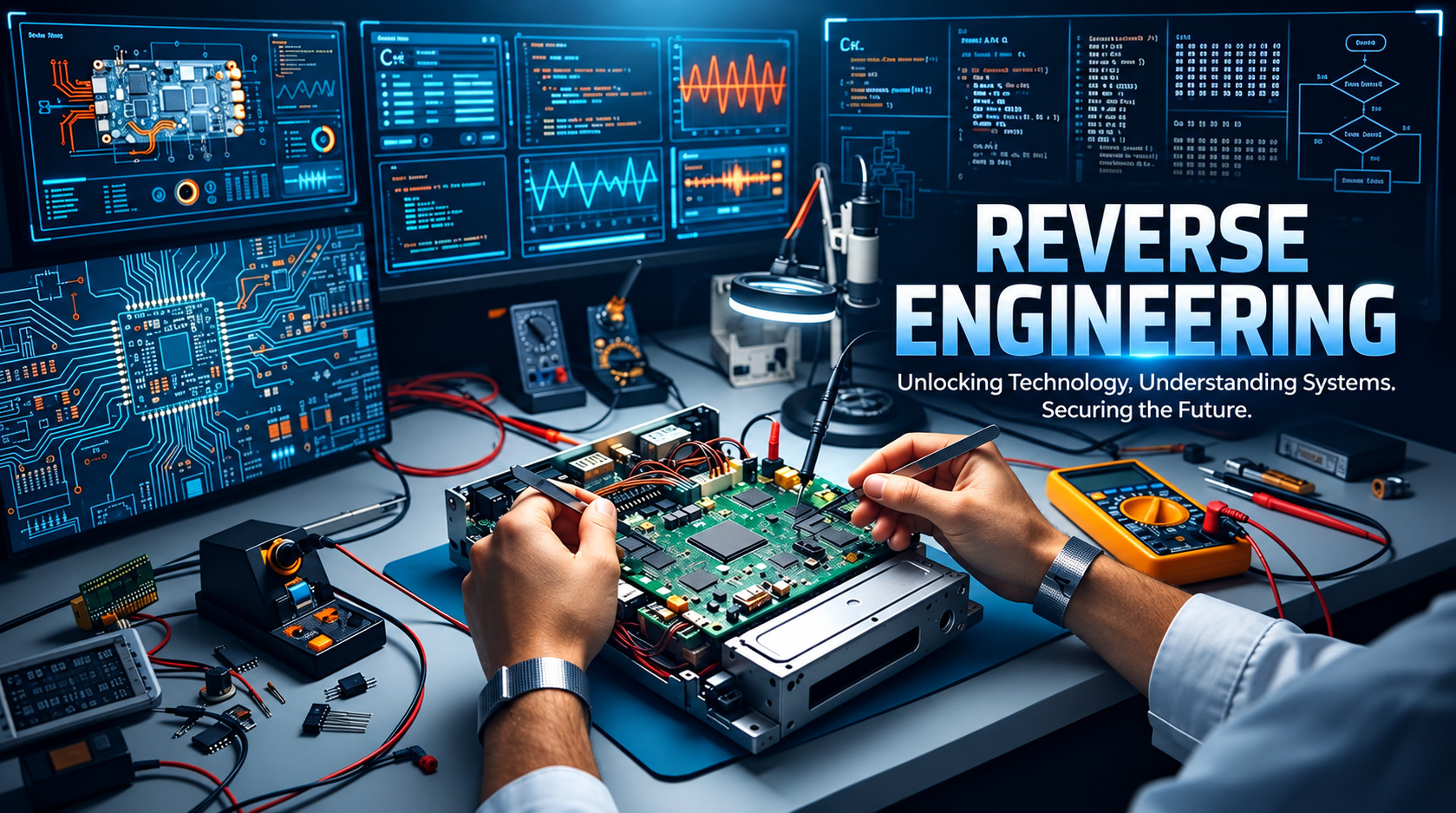
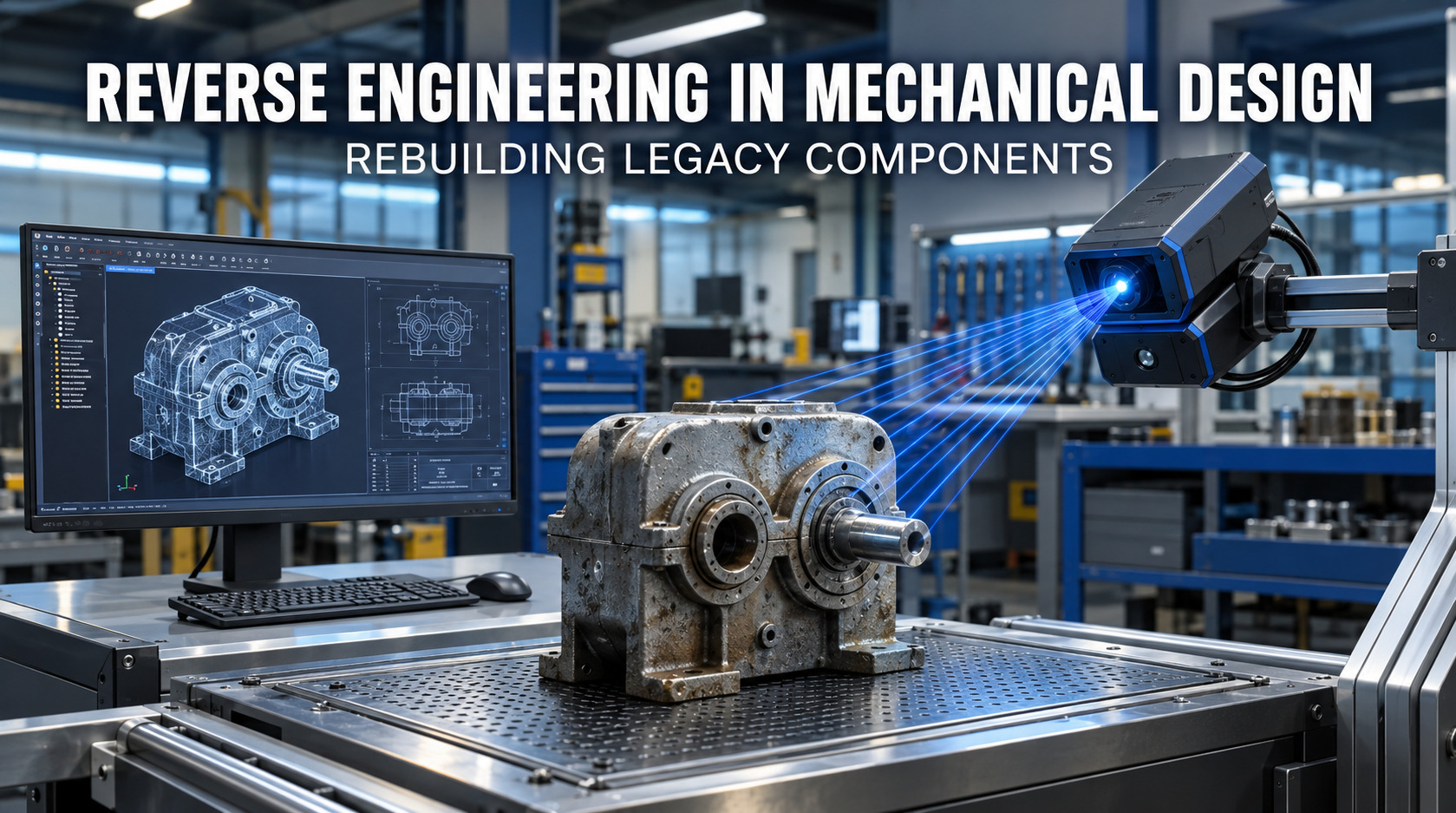
A clean engineering workspace shows the reverse engineering process that takes a component and turns it into digital data. The banner shows a mechanical component being looked at and measured next to a computer screen that displays its CAD reconstruction, a technical drawing and the engineering dimensions. Small PCB and electronic details can be added to show reverse engineering and PCB reverse engineering. The overall look should be modern, realistic, clean and industrial, with a B2B engineering vibe.
Reverse engineering is the process of analyzing an existing product, component, machine, PCB, or system to recreate its design, specifications, and functionality when original engineering data is unavailable.
Instead of designing completely from scratch, engineers work backward from a physical object to recover CAD models, manufacturing drawings, materials information, technical specifications, and design intent.
Reverse engineering is commonly used for obsolete parts, missing documentation, legacy product redesign, PCB analysis, product modernization, and competitive product analysis.
The 4 Most Common Reasons Companies Need Reverse Engineering
If you're wondering when reverse engineering becomes necessary, these are four common situations where it can provide practical value.
1. Obsolete Parts and Components
A critical component may no longer be manufactured, while the equipment that uses it is still operational. Reverse engineering can help recreate the required engineering information for producing a replacement.
2. Missing Drawings and Documentation
CAD files, schematics, manufacturing drawings, or engineering records may be unavailable because of data loss, company changes, outdated storage systems, or discontinued software.
Reverse engineering allows engineers to recover important product information from the existing physical component or assembly.
3. Legacy Product Redesign
Older products may continue to work but require modernization, cost optimization, material changes, improved manufacturability, or integration with newer technologies.
A reverse-engineered digital model can provide a starting point for redesign.
4. Competitive Product Analysis
Companies may analyze existing products to understand design approaches, manufacturing methods, component selection, and potential areas for improvement.
The objective can be benchmarking and engineering analysis rather than simply reproducing an existing product.
What Is Reverse Engineering?
Reverse engineering is the practice of examining a finished product and working backward to determine how it was designed, manufactured, and assembled.
Consider a machine component that has been operating for many years. The machine still works, but its original supplier may no longer exist and the original engineering drawings may be unavailable.
In this situation, the physical component becomes an important source of engineering information.
Engineers can inspect the part, capture dimensions, analyze materials where required, recreate CAD models, prepare manufacturing drawings, and rebuild the documentation needed to manufacture or improve the component.
This process helps organizations preserve valuable engineering information that might otherwise be difficult to recover.
Why Is Reverse Engineering Important for Legacy Equipment?
Many industrial facilities continue to operate equipment that was designed and manufactured years or even decades ago.
As equipment remains in service, its original documentation can become difficult to access.
Engineering information may be affected by:
- Factory relocations
- Company acquisitions or mergers
- Retiring employees
- Legacy storage systems
- Discontinued software platforms
- Supplier shutdowns
- Lost or incomplete engineering records
When original documentation is unavailable, reverse engineering can provide a practical way to recover critical product information from the physical product itself.
How Does Reverse Engineering Work?
A professional reverse engineering project generally follows a structured workflow. The exact process depends on the product, required accuracy, materials, manufacturing process, and final deliverables.
Step 1: Physical Product Assessment
Engineers first inspect the component, assembly, or product to understand the project requirements.
The assessment may consider:
- Functionality
- Critical dimensions
- Interfaces
- Material requirements
- Manufacturing constraints
- Visible wear or damage
- Assembly relationships
The goal is to understand what information needs to be recovered before detailed measurement begins.
Step 2: Data Capture
Measurements and physical data can be collected using appropriate inspection equipment and techniques, such as:
- Calipers and precision measuring instruments
- Coordinate Measuring Machines (CMM)
- Laser scanners
- Structured light scanners
- Digital inspection systems
The selected method depends on the size, geometry, complexity, tolerance requirements, and condition of the component.
Step 3: Geometry Reconstruction
Captured measurements and scan data are converted into engineering information such as:
- 3D CAD models
- Engineering drawings
- Manufacturing documentation
- Reference geometry
For complex components, engineers may need to interpret the design intent rather than simply reproduce the measured surface.
Step 4: Material Analysis
Where necessary, additional analysis can help determine information about:
- Material type
- Surface treatments
- Hardness
- Manufacturing characteristics
- Material-related specifications
Material analysis may require specialized testing depending on the project requirements.
Step 5: Validation
The recreated model is compared with the physical product to check dimensions, geometry, interfaces, and other important characteristics.
Validation helps identify measurement errors and ensures that the reconstructed engineering data represents the physical component accurately.
Step 6: Documentation Creation
Depending on the project scope, final deliverables may include:
- CAD files
- Manufacturing drawings
- Bills of Materials (BOMs)
- Technical documentation
- Production specifications
- Inspection data
The final objective is to transform a physical product into a usable digital engineering asset.
Scenario 1: Obsolete Parts Are No Longer Available
One important industrial application of reverse engineering is the recreation of obsolete components.
Consider a machine that stops operating because a critical component has failed. The original component may no longer be manufactured, the OEM may no longer support the equipment, or replacement parts may be unavailable.
In these situations, reverse engineering can help recreate the engineering information required to develop a replacement.
Depending on the component, engineers may recreate:
- CAD models
- Manufacturing drawings
- Material specifications
- Dimensional information
- Replacement part documentation
This can help organizations maintain older equipment without having to redesign the entire machine.
Need Help Recreating Obsolete Parts?
Explore Rhosigma's Reverse Engineering Services for engineering support related to legacy components, product analysis, and design reconstruction.
Scenario 2: Engineering Documentation Has Been Lost
Many organizations have products or machines with incomplete engineering documentation.
Sometimes the original documentation was never created digitally. In other cases, drawings and CAD files may have been lost during data migration, company acquisitions, software changes, or organizational restructuring.
Without accurate documentation, engineers may face difficulties when they need to:
- Manufacture replacement parts
- Modify existing products
- Improve designs
- Maintain production consistency
- Transfer manufacturing to another supplier
Reverse engineering can help rebuild this information from the physical product.
Instead of relying on assumptions, engineers can use measurable physical data to recreate the required engineering documentation.
Scenario 3: Legacy Product Redesign and Modernization
A product can continue to perform its intended function while its design or manufacturing process becomes outdated.
Reverse engineering can provide a digital foundation for modernization projects involving:
- Replacement of obsolete materials
- Improved manufacturability
- Production cost optimization
- Component upgrades
- Electronics integration
- Reliability improvements
- Design modifications
Instead of starting from an entirely new concept, engineers can use the existing product as a reference point.
This approach can help preserve proven functional characteristics while providing a foundation for further development.
Scenario 4: Competitive Product Analysis
Reverse engineering can also support product teardown and competitive engineering analysis.
Companies may study an existing product to understand:
- Product architecture
- Component selection
- Manufacturing methods
- Mechanical design
- Electronics architecture
- Design approaches
- Potential areas for improvement
The objective is not necessarily simple replication.
Engineering analysis can instead help organizations understand how a product works, compare different design approaches, and identify opportunities for future product development.
Any competitive analysis should, of course, be conducted while respecting applicable intellectual property rights, contracts, and other legal requirements.
Reverse Engineering vs Traditional Engineering
Traditional engineering and reverse engineering approach product development from different starting points.
Traditional Engineering
Traditional engineering generally begins with a concept or set of requirements.
Idea → Design → Prototype → Testing → Manufacturing
Reverse Engineering
Reverse engineering generally begins with an existing physical product or system.
Physical Product → Analysis → Data Capture → CAD Reconstruction → Validation → Manufacturing
Both approaches have important roles in product development.
Traditional engineering creates new designs, while reverse engineering helps recover and understand existing engineering information.
In some projects, the two approaches work together. A reverse-engineered product can become the starting point for a new engineering or redesign project.
Reverse Engineering for Electronics and PCB Assemblies
Mechanical components are not the only products that require reverse engineering.
Electronics companies may need to recover engineering information from:
- Printed Circuit Boards (PCBs)
- Embedded systems
- Industrial controllers
- Legacy electronic products
- Electronic assemblies
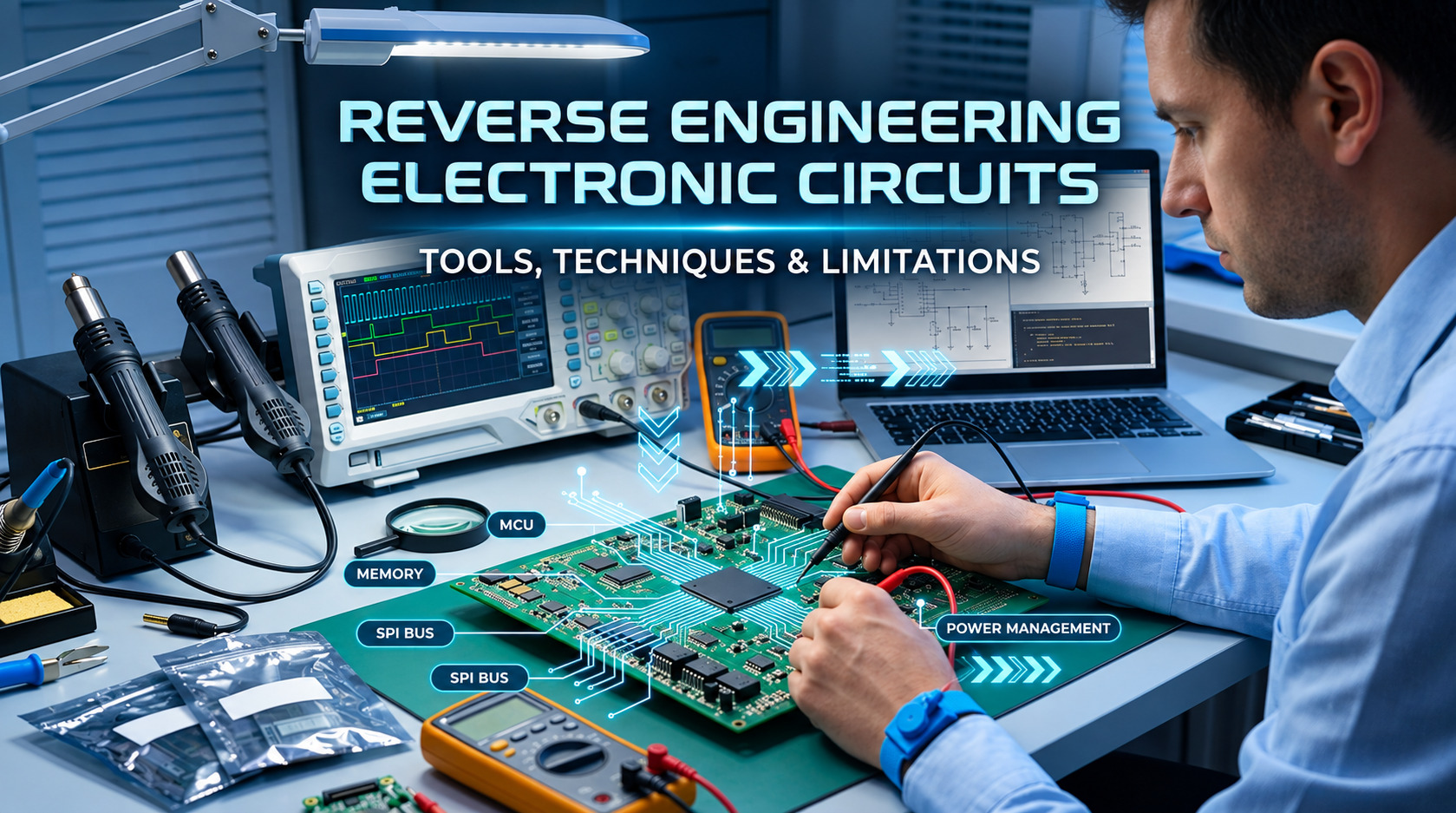
PCB reverse engineering can involve:
- PCB layer analysis
- Circuit tracing
- Component identification
- BOM recreation
- Schematic generation
- Connectivity analysis
- Board documentation
This can be particularly useful when original PCB design files, schematics, or component documentation are unavailable.
For long-life electronic products, PCB reverse engineering can support maintenance, redesign, replacement production, and product modernization.
Reverse Engineering for Embedded Hardware and Firmware
Modern industrial equipment increasingly depends on embedded hardware and firmware.
When original documentation is unavailable, engineering teams may need to understand information related to:
- Microcontroller-based products
- Industrial automation systems
- IoT devices
- Embedded hardware platforms
- Communication interfaces
- Peripheral connections
Reverse engineering can help identify hardware architecture, interfaces, component relationships, and functional behavior.
This information can provide a foundation for modernization, redesign, troubleshooting, and long-term product support.
For projects involving both physical electronics and software, hardware and firmware analysis may need to be considered together.
What Technologies Are Used in Reverse Engineering?
Modern reverse engineering projects can use a combination of measurement, scanning, inspection, CAD, and analysis technologies.
3D Laser Scanning
Laser scanning captures geometric information from physical components and can be useful for complex shapes and surfaces.
Structured Light Scanning
Structured light scanning uses projected patterns to capture detailed surface geometry.
Coordinate Measuring Machines (CMM)
CMM systems measure physical dimensions with high precision and are commonly used when dimensional accuracy is critical.
CAD Software
CAD software is used to convert measurements and captured geometry into usable engineering models and drawings.
Material Analysis Equipment
Material analysis can help identify material composition and relevant properties when geometry alone is insufficient.
Digital Inspection Systems
Digital inspection tools help compare recreated models and measurements against the original physical component.
The appropriate combination of technologies depends on the product geometry, accuracy requirements, material, condition, and intended use of the reconstructed data.
Benefits of Reverse Engineering
Organizations use reverse engineering for several practical engineering and business reasons.
Reduced Equipment Downtime
Recreating obsolete components can help support maintenance and replacement requirements for legacy equipment.
Lower Development Effort
Existing products provide a physical reference, reducing the need to begin product development without any design information.
Faster Redesign
A recovered CAD model or engineering drawing can provide a starting point for product modifications and modernization.
Improved Documentation
Reverse engineering can help recover missing CAD files, drawings, specifications, and other engineering information.
Extended Equipment Life
Supporting replacement parts and documentation can help organizations continue operating legacy equipment.
Manufacturing Optimization
Once a digital model exists, engineers can evaluate potential changes to geometry, materials, manufacturing methods, or tolerances.
Knowledge Preservation
Reconstructed engineering information can remain available even when original employees, suppliers, or documentation systems are no longer accessible.
Common Challenges in Reverse Engineering Projects
Although reverse engineering can be highly useful, it also presents technical challenges.
Wear and Damage
A physical component may have been exposed to years of wear, corrosion, deformation, or damage.
Engineers must distinguish the original design from changes caused by service conditions.
Missing Material Information
Geometry alone does not always reveal the original material.
Additional material testing may therefore be required depending on the application.
Complex Assemblies
Products containing many interacting components can require extensive inspection, measurement, disassembly, and analysis.
Legacy Manufacturing Methods
Older components may have been manufactured using processes, tooling, or materials that are no longer commonly available.
The reconstructed design therefore needs to consider not only geometry but also practical manufacturing requirements.
Tolerance and Design Intent
A measured physical dimension does not always represent the intended nominal dimension.
Understanding tolerances, fits, interfaces, and functional requirements is therefore an important part of professional reverse engineering.
How to Choose a Reverse Engineering Partner
Selecting an engineering partner is an important part of a successful reverse engineering project.
Depending on the project, look for experience in areas such as:
- Mechanical systems
- PCB reverse engineering
- Embedded hardware
- CAD modeling
- Dimensional inspection
- Manufacturing support
- Product redesign
- Engineering documentation
A capable engineering team should do more than measure dimensions.
It should understand the relationship between geometry, function, materials, tolerances, manufacturing requirements, and design intent.
That broader engineering understanding is particularly important when the reconstructed information will be used for manufacturing or product redesign.
Why Businesses Choose Professional Reverse Engineering Services
Anyone can measure basic dimensions from a physical component.
Professional reverse engineering requires a broader understanding of engineering and manufacturing.
A complete project may involve:
- Functional analysis
- Dimensional inspection
- Material evaluation
- CAD reconstruction
- Tolerance interpretation
- Manufacturing considerations
- Validation
- Technical documentation
The objective is not simply to create a visual copy of a component.
The objective is to create engineering information that is accurate, useful, manufacturable, and suitable for the intended application.
Whether you need obsolete part recovery, PCB reverse engineering, legacy product redesign, or engineering documentation recovery, professional reverse engineering services can provide a structured path from physical product to usable engineering data.
Frequently Asked Questions
What is reverse engineering?
Reverse engineering is the process of analyzing an existing product, component, or system to recover its design, functionality, dimensions, and engineering information when original documentation is unavailable.
Why do companies use reverse engineering?
Companies use reverse engineering for applications such as obsolete part recreation, engineering documentation recovery, legacy product redesign, PCB analysis, product modernization, and technical analysis.
Is reverse engineering legal?
The legality of a reverse engineering project depends on factors such as jurisdiction, intellectual property rights, contracts, licensing terms, and the intended use of the resulting information. Organizations should obtain appropriate legal advice when proprietary or third-party designs are involved.
Can reverse engineering recreate CAD files?
Yes. Depending on the physical product and available measurement data, reverse engineering can be used to create 3D CAD models, engineering drawings, and other technical documentation.
What industries use reverse engineering?
Reverse engineering is used across industries including manufacturing, industrial automation, automotive, aerospace, electronics, energy, medical-device development, and other engineering-intensive sectors.
How long does a reverse engineering project take?
Project duration depends on product complexity, size, geometry, condition, required accuracy, available samples, documentation requirements, and validation needs. Simple components may require relatively little time, while complex assemblies can take considerably longer.
Can reverse engineering help with PCB and electronics products?
Yes. PCB and electronics reverse engineering can involve circuit tracing, component identification, board-layer analysis, schematic recovery, BOM development, and embedded hardware analysis.
Conclusion
Reverse engineering is an important engineering capability for organizations that need to recover lost product information, support obsolete equipment, modernize legacy designs, or understand existing products.
Whether the challenge involves a discontinued spare part, missing engineering documentation, a legacy mechanical product, or a complex PCB assembly, reverse engineering provides a structured path from a physical product to digital engineering information.
By combining physical inspection, accurate measurement, CAD reconstruction, material analysis, validation, and technical documentation, organizations can create a useful engineering foundation for manufacturing, maintenance, redesign, and product development.
For companies looking to extend equipment life, recover engineering knowledge, support legacy products, or modernize existing designs, reverse engineering can provide a practical starting point.
Recover lost designs, recreate obsolete components, modernize legacy products, and support product development with professional engineering expertise.