4-20mA and HART Protocol Together: How Analog and Digital Coexist
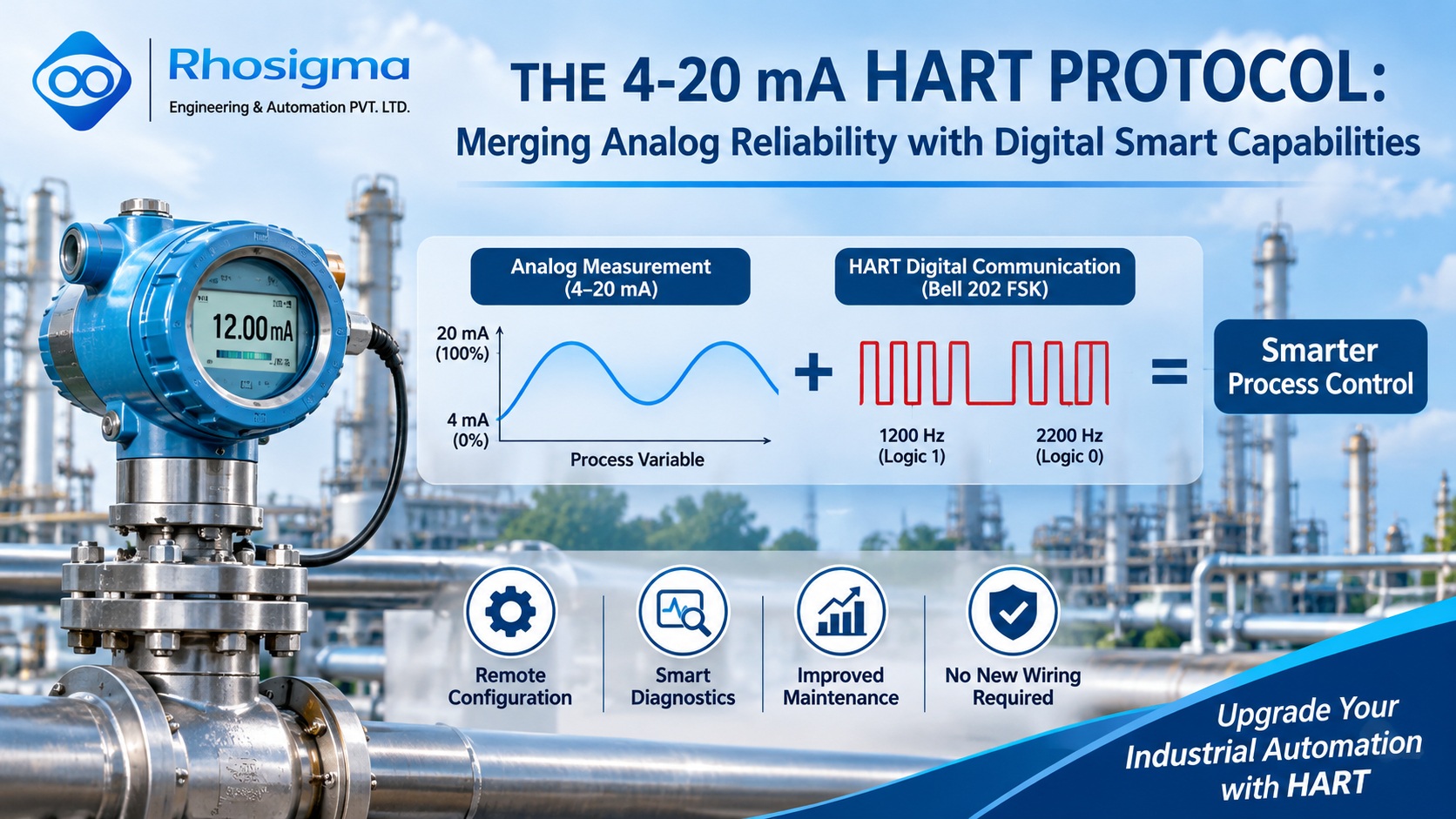
Learn how the 4–20 mA HART protocol brings together analog signals and digital communication to make instrumentation better. See how it works how devices are set up how it is put into practice, where it is used and the advantages it offers for process control.
The 4 20 mA HART protocol allows industrial devices to send both analog measurement signals and digital data through the same twisted pair wiring. The protocol allows for bidirectional communication while using the conventional 4–20 mA current loop. The control loop maintains operation through the continuous flow of the analog signal. The digital signal delivers configuration information together with diagnostic data and supplementary process information. The 4 20mA HART protocol manages both without interfering with each other
HART does not replace the traditional 4–20 mA current loop. Instead, it adds bidirectional digital communication while preserving the existing analog measurement signal.
What is the 4 20 mA HART Protocol?
HART (Highway Addressable Remote Transducer) is a bidirectional communication protocol that enables digital communication over a conventional 4–20 mA analog current loop. It uses Frequency Shift Keying (FSK) to superimpose digital signals onto the existing analog signal, allowing field devices and control systems to exchange information through the same pair of wires.
The 4 20 mA HART protocol is particularly useful for industries that want to upgrade conventional instrumentation with digital communication capabilities without replacing their existing wiring infrastructure.
HART was originally developed by Rosemount in the mid-1980s to enable digital communication over existing 4–20 mA instrumentation wiring. The HART Communication Foundation was later established to support and manage the protocol. In 2015, the HART Communication Foundation merged with the Fieldbus Foundation to form FieldComm Group, which continues to support the development and management of HART technology. This approach helped industries add digital communication capabilities to existing instrumentation without replacing their entire wiring infrastructure.
A few loop basics help here:
- 4 mA marks the bottom of the measurement range (0%) and 20 mA marks the top (100%).
- The "live zero" at 4 mA means a broken wire (0 mA) is easy to spot.
- NAMUR NE43 treats currents below 3.6 mA or above 21 mA as a device fault.
How does the 4 20 mA HART protocol put data on an analog loop?
HART encodes digital bits as two audio tones, 1200 Hz for a 1 and 2200 Hz for a 0 using Bell 202 frequency shift keying at 1200 bits per second and lays them over the DC loop current, as an AC wave of about 0.5 mA that averages to zero.
That one sentence is the whole trick behind the 4 20 mA HART protocol. Here is the same idea as a quick spec list:
- Signal amplitude: approximately ±0.5 mA (around 1 mA peak-to-peak)
- Data rate: 1200 bits per second, half-duplex
- Frequencies: 1200 Hz (logic 1) and 2200 Hz (logic 0)
- Cable: The same twisted pair used for the 4–20 mA process signal.
Imagine a small radio station broadcasting through a constant hum. The hum is your process variable. The station is the HART protocol.
Why does the HART signal not cause any problems with the analog reading?
Because the FSK wave averages out to zero during each cycle the DC level that is used for the measurement stays the same. The transmitter, which has an output of 12mA, continues showing 12mA on the meter even while HART is enabled.
The process variables vary more gradually than the 1200Hz tone. The standard analog input cards filter off the variations and thus the control system cannot sense any variation. It is for this reason that a 4 to 20 mA HART protocol can always be upgraded without altering the control scheme.
What Is Required for a Loop to support the 4 20 mA HART protocol?
- It requires very little, except that some points confuse many users:
- Loop resistance must be at least 250 ohms for tone detection by the modem.
- Up to approximately 3,000 metres (10,000 feet) under suitable conditions. The actual maximum distance depends on cable capacitance, cable characteristics, loop resistance, and the number of connected devices.
- Either a HART modem, a HART enabled IO card or hand-held unit at the host side.
- HART-compatible barriers, isolators and signal conditioners. Some old devices do not pass tones through, thus they must be tested.
What does HART add to a 4-20mA HART Protocol?
A HART transmitter still sends its main measurement as 4-20mA, then adds a digital channel next to it. That channel is what turns a basic transmitter into Smart transmitter communication.
HART exposes four dynamic variables: PV (primary), SV (secondary), TV (tertiary) and QV (quaternary). Only the PV rides on the analog current. The rest travel digitally.
You also get:
- Range values (LRV and URV), the process values that map to 4 mA and 20 mA
- Tag, damping and unit settings
- Device status and diagnostic flags
- Trim and calibration commands
This is where HART device configuration saves real time. The technician can modify a range either from the control room or anywhere on the loop without having to go up the tower.
What is the difference between point-to-point and multidrop operation of 4 20mA HART?
Point-to-point is the default operation mode. The analog loop transmits the PV, while HART transmits everything else. In multidrop operation, multiple devices use the same wire pair with loop current fixed at 4 mA.
| Parameter | Point-to-point | Multidrop |
|---|---|---|
| Analog signal | Active 4–20 mA | Fixed 4 mA |
| Device configuration | One field device | Multiple field devices |
| Typical application | Process control | Monitoring applications |
| Communication | Analog + digital | Digital communication |
Multidrop is slower, since each poll takes time at 1200 bits per second. Use it for monitoring, and keep critical control on point-to-point loops.
Where do HART protocol devices fit in a real plant?
HART protocol devices include pressure, temperature, flow and level transmitters, plus valve positioners and other HART instrumentation. Any of them can share a loop with ordinary analog gear.
In practice, you will see HART enabled devices on 4 20 mA HART protocol loops in refineries, chemical plants, pharma lines and water treatment. A technician plugs a HART field communicator into the loop, reads the device and fixes a setting, all without shutting anything down.
WirelessHART, standardized as IEC 62591, carries the same device data without wires. It is useful where cable runs are expensive.
How is HART protocol implementation done?
HART protocol implementation has two sides: building it into a device, and wiring devices into a plant.
On the device side, a firmware team typically needs:
- A Bell 202 modem or modem chip on the loop interface
- A protocol stack that handles universal, common-practice and device-specific commands
- A device description (DD) file so host tools understand the instrument
- Compliance testing and registration through FieldComm Group
On the plant side, field device integration involves connecting HART-enabled instruments with a Distributed Control System (DCS), Programmable Logic Controller (PLC), or asset management software. This integration allows digital device information, diagnostics, and process data to be accessed through the host system. Proper configuration and compatibility between field devices and control systems are essential for reliable communication.
Rhosigma provides HART communication integration and field device engineering services for industrial process control applications, covering firmware development, device integration, and host-side configuration.
Which errors do you need to watch out for using the 4 20 mA HART protocol?
Most HART communication issues result from incorrect wiring, incompatible loop components, insufficient loop resistance or configuration problems.
Here is a quick list of what to watch out for:
- Not knowing about the 250 ohms minimum, and then being confused as to why your handheld can't see a device
- Failing to remove the non-HART transparent isolator from the circuit
- Expecting an analog value in multidrop mode (it sits at 4 mA, always)
- Skipping the right DD file, so the host shows generic data only
- Running long cable next to noisy motor wiring
None of these is dramatic. All of them waste an afternoon.
Is there any point in using the 4 20 mA HART protocol in the presence of advanced fieldbuses?
Yes. For plants that already use conventional 4–20 mA instrumentation systems, the HART protocol provides a practical way to introduce digital communication without replacing the entire existing infrastructure. It allows industries to retain compatible wiring, I/O cards, and control strategies while accessing additional information from smart field devices.
This is the reason why it is widely used as a retrofitting protocol for process control instrumentation and as an industrial communication protocol.
Conclusion
The 4–20 mA HART protocol continues to play an important role in industrial automation by combining reliable analog measurement with digital communication. It allows industries to access device diagnostics, configure smart instruments remotely, and monitor additional process information while retaining their existing 4–20 mA infrastructure.
For businesses using conventional process instrumentation, HART provides a practical way to improve device connectivity, simplify maintenance, and support industrial automation upgrades without completely replacing existing wiring systems.
Successful HART implementation requires compatible field devices, appropriate loop components, and reliable integration with control systems. Working with an experienced engineering team can help ensure smooth communication between field instruments and host systems.
FAQs
1. Does the 4 20 mA HART protocol replace the analog loop?
No, it rides on top of the 4-20mA loop and allows it to continue operating.
2. At which frequencies does the 4 20 mA HART protocol operate?
At 1200 Hz for a logic 1 and 2200 Hz for a logic 0, with a speed of 1200 bits/second.
3. Can I use HART without a HART-compatible control system?
Yes, a handheld field communicator or HART modem may communicate with the device while the control system measures the analog signal.
4. How many devices can share one HART loop?
One device can operate in point-to-point configuration. In multidrop mode, a HART 5 network can support up to 15 field devices, while HART 7 can support up to 62 field devices, depending on system configuration.
5. What is the minimal loop resistance needed for HART operation?
It should be at least 250 ohms.
6. Is there wireless HART communication possible?
Yes, with the help of WirelessHART, which is standardized in IEC 62591.
Need help with your 4 20 mA HART protocol project?
Planning HART protocol implementation or integrating a HART transmitter into your plant? Talk to our HART team and Get Quote today.